Thursday, March 24, 2011

Trip to school

Many people have asked the girls about school here. Now that they are well integrated into their classrooms, I'll try to get them to sit for another interview. Meanwhile I thought it would be of interest to share how we get there. In Madison we live about a 5 minute walk as the school is at the bottom of our street. Here it is a 20 minute walk, but not quite as typical as a walk through Madison. Here is our journey in pictures.


On the left is the street our flat is on. We walk up the hill and through a short pedestrian walk (on the right). From there we cross a crazy roundabout intersection and head downhill.


The blue building in the picture to the right is the library and cultural information center. The library is quite small but functional. It is not as integrated as the Madison system with all the other libraries in the area.


From there we follow a rather long street until it ends in what is left of countryside in Algorta.

We see lots of wildlife along the way. There are goats, occasionally roosters, cats, lizards and ducks. The goats and roosters are typically hanging out in the same field. As we continue our walk down the road we see our first set of cats. A couple of them come running to be greeted by the girls both in the morning and on our way home. We need to add a few extra minutes to our journey so the girls can get their kitty fix.


As we continue our journey we reach the end of this quiet road and are greeted by a rather busy roundabout intersection. Crossing there we pass under a highway and cross the street. This area is a very quiet neighborhood with mostly flats and a few stores but not nearly as active as the area in which we are living. There is a metro stop here so on really rainy days, the girls prefer the metro over the exercise. Ok, actually, everyday they would prefer the metro over the exercise, they just don't get that option ;-).
 
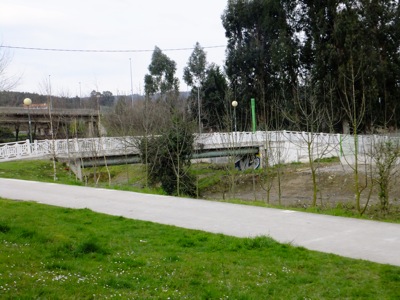
Our journey ends as we hit the little river and cross the bridge to their school. We typically see a couple more cats who are very skittish and several ducks.


On the left is the back of the school and the playground area for the elementary school kids. The picture on the right is the front of the school which has a couple of playsets for the younger kids. The school day begins and ends in this part of the school yard. Just as with Thoreau School in Madison, the kids line up by class to enter the building.
I hope you have enjoyed the picturesque journey between the mountains that we take daily to get to and from school. It's amazing to pass such a diversity of urban and rural settings in just a 20 minute walk.

Saturday, March 19, 2011

Excursions in Euskadi

We decided to rent a car for the weekend and head out on our first official excursion. Of course at the time we reserved the car we didn't plan on three out of four of us being quite ill during the week. Arming ourselves with cold meds and a sense of adventure, we crossed our fingers and headed out the door.

Our plan was a combination of sightseeing and seeing friends along the way. We began our journey around 10am, a car full of snacks, cameras in hand, and a GPS. We drove along the coast to San Juan de Gaztelugatxe. The drive was quite nice although the highways were curving around through the mountains so not the best for those with a tendency towards motion sickness.

We were most of the way there when the views caught our eye and we had to stop for a photo shoot. We were in the small town of Bakio. It was a really nice area and seemed to be the perfect place for a vacation home by the ocean. While it isn't far from Bilbao, it didn't appear to be as easily connected to the big city as where we are living; a car or bus ride away. These first pictures are what we saw.

We continued our journey along the coast guided by our GPS. Most of the time that works well. However, this time it took us, as it turns out, past our destination and to where the highway ends, literally. Apparently it has been closed for a couple of years due to fallen rock. We pulled over, got out, and could see the island we were trying to reach. This time guided by our gut we backtracked and found a parking area where we could catch a not very well marked trail.

As you can see the views were spectacular. The staircase consists of approximately 230 stairs. That part really wasn't bad at all though. At the top is a small church that dates back to the 10th Century. We were lucky enough to enter. In most cases the building is closed.  In addition to the church, there is a nice covered area with stone picnic tables and a fireplace. You may have noticed in the pictures that Morgan is ringing a bell. It is supposed to be good luck to ring the bell three times and make a wish. (My wish was for no more trips to the clinic...)

I have to admit, it took me all weekend to learn to pronounce Gaztelugatxe, a word in Euskera. Since I worked so hard at it, I thought you would be interested to know its meaning. Gaztelu is castle and aitz is rock or bad. So it is either Castle on the Rock or Bad Castle. You can choose.

After spending some time taking in the views at the top we headed back down. The underneath part of the stone bridge that connects the island to the land has two arches. You can catch those in the pictures as well. We spent about an hour climbing around on the rocks, looking at snails and finding the tiniest shells ever. The last part was the hardest. Climbing back up to the parking area. I don't really know why it was so hard. Perhaps because that part of the walk is much less inspiring.

Once back at the car we needed to head to Guernika where we met up with Marina, an exchange student who lived in Madison last year. She is from Mundaka, just outside of Guernika. She and her parents took us to a restaurant where we sat overlooking the countryside and filled our bellies with roasted chicken, salad and french fries. The setting was beautiful and the company outstanding. It was really nice to meet her parents and to see Marina again, only this time in her home setting.

Following our meal we went to Bosque de Oma.  It was a long walk in but once we found the painted forest it was well worth it. The tree trunks were painted by Agustín Ibarrola, a Basque artist who lives in the village below the forest. We aren't sure in which one of the houses but you can see the village in the pictures below.

In any case, this is by far the most unique forest I have ever ventured through. In addition to the painted trees, there are triangle numbered markers on the ground. The idea is that you stand on the marker looking in the direction it is pointing and from there you see the works of art created by Ibarrola. He managed to paint tree trunks such that looking at groups of them together you see a variety of shapes and designs. Very curious. My suspicion is that he occasionally must return to the forest to repaint as the weather must wear away at his art work.

After locating the 40+ markers we made our way down the hill and walked through the small town below. The total trip was a couple of hours at least. Lots of walking but well worth. We ended our visit with a really nice bar on the beach near the ocean just across from Mundaka. We look forward to our next visit with Marina and her parents when we hope to visit her home town and other beautiful cities along the way.

We returned home Saturday night quite late, exhausted, but energized by our excursion. We knew we needed sleep as Sunday we had plans to visit our friends in Victoria. We definitely were getting the most out of our rental car.

Sunday came fast. Our first stop was Murgia, a small town on the way to Vitoria. It was there that we met up with our friends Rosa, José, Sara and Marta. They took us up to the top of a rocky mountain, Las Penas de Oro where we found Nuestra Señora de Oro, a small church, accompanied by more outstanding views. (For those of you who don't speak Spanish, you can translate those sites pasting the URL in at translate.google.com. It's not perfect but will give you the gist.)

Following our mountain top pictures, we headed to Vitoria where we visited Salburua nature preserve. The museum describing how they restored the area was quite interesting and we could have definitely used more time to explore it. Unfortunately they close at 2 for lunch and reopen later in the evening. This is typical of most businesses. I find it amazing that Spain has continued to preserve so much of this tradition. It is also not possible to shop on Sundays as nearly everything is closed. Fresh bread and pastry is available, video rentals, movie theaters, museums, etc. However grocery/food stores, clothing stores and the like are all closed.

Following the nature preserve we headed for lunch and spent the rest of the day just enjoying our time together. The girls really welcomed the opportunity to spend time with Sara and Marta, who are 12 and 10.

The drive home was uneventful but most importantly, we knew this was the beginning. We hope to make the most of our time here and enjoy similar excursions as we get to know more about the area in which we are living.

Sunday, March 13, 2011

Carnaval

In Schools
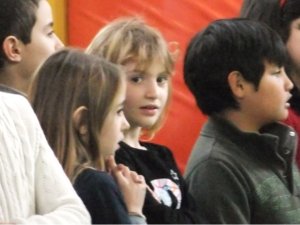
Last weekend was Carnaval here in the Basque region of Spain. It resembles Halloween in that people are in costume and out in the street but they don't go door to door. There is lots of dancing and singing and celebrating though. In school, all the kids had to dress up. Each class was assigned a particular theme that met with an overall school theme and they performed dances in the school yard. This year's theme for Maia and Morgan's school was Music: Past and Present. Morgan's class dressed in some sort of a Russian themed costume, danced to a song from days of old and then to Thriller. Maia's class was something out of yesteryer with white wigs and long gowns.  As you can imagine, she was not too thrilled about the wig part. Her class also danced to the sounds of Bach followed by Lady Gaga.

In the Streets
In addition to the celebrations in schools, the rest of the city celebrates in the streets all weekend. There were a number of parades and a variety of bands from today's music to traditional sounds and instruments, including both Spanish and French Basque regions. In the slide show you will see the gigantes y cabezudos (giants and big heads) which march through the streets. Notice the bags the big heads are holding. They use those to randomly wack people in the streets chasing both children and adults. Pictures were taken in Algorta, the town where we live, and Bilbao, the large city several metro stops away.

At night young people head out in costumes that are quite well done and enjoy carnaval celebrations into the wee hours of the morning. The costumes are often quite elaborate and done in groups to particular themes chosen by the groups. This continues for two weekends in a row and from what I can tell they look forward to it all year long in the same way as our kids look forward to Halloween.

Saturday, February 26, 2011

Santa Águeda


As I have mentioned in earlier posts we are in the mountains and back before the days of global warming they used to see lots of snow here. Not unlike what we have known in Wisconsin. Of course hundreds of years ago there weren't ways to bring fresh foods and not much grows in the winter. So, in late January/early February many people were hungry and they took up the tradition of going from door to door singing the praises of those who lived there and asking for a little food. These songs and chats were in Euskera, the language of the Basque people.

Today the tradition has evolved a bit. Groups of people still gather together, sing and chant going from door to door, business to business but they usually are representing a cause for which they hope to earn a bit of money instead of food. The song is in Euskera and they have a stick decorated with the colors of Euskadi, the Basque region, which they rhythmically pound on the ground. At night there are groups of adults dressed in traditional clothing going through the streets in front of businesses singing for their cause and stopping for glasses of wine along the way.
School children also do this in groups and here is a 2+ minute video taken with my point and shoot camera of what Morgan and Maia's school performed in the streets near their school.

History
Here's a bit of what I learned about the history behind the festival. When the Catholics moved in to take over and spread their religion, they arrived in the Basque region and were a bit lost in what to do. They had no ability to understand the language as there are no Latin origins found in Euskera. They couldn't grow their wheat or their grapes for wine because of the cold climate. They did however want to infiltrate their beliefs. They realized that the Basque people are strong and not willing to give up their lifestyles and celebrations. So, the Catholics decided to let them celebrate as they always did but that they must name their holidays after saints.

This particular celebration took on the name of Santa Águeda although there is not any relation that we can find other than suffering. Santa Águeda back in 200 AD was a virgin martyr. Apparently a senator named Quintianus wanted to take her for himself as part of the persecutions realized by Emperor Decio and she refused. He had her tortured and killed.

There is no relationship to the Saint and the celebration but the Catholics get credit for realizing the best way to move their beliefs into a culture they had no connection with was to simply rename their holidays.

Monday, February 14, 2011

SUV

We finally found an SUV.


Although it appears that someone put it in the washer using very hot water (as Dean suggested)...


For those of you who haven't traveled to Europe, the vehicles in general are much smaller. As I learned today from some of my new friends, they like to take pictures of our GIGANTIC vehicles when they visit us as much as we like to take pictures of their miniature ones.

Thursday, February 10, 2011

Día de Paz--Day of Peace

A couple weeks ago there was a celebration on a Friday afternoon at the kids school called Day of Peace. All the students including the preschool kids participated. Each class had a word that was their contribution to a school poster. The words represented part of what was necessary in order to have world peace. Morgan was the representative selected from her class to put the word on the poster. Unfortunately I haven't been able to get a picture of the final product but it had words in Spanish such as friendship, listening, understanding...
Following the poster there were various songs including one by Morgan's class, poetry by several students of varying ages, and flute playing by Maia's class. I have a short rather poorly done video of the kids doing their parts. The video was taking with a point and shoot camera being hold up high to be able to see over peoples heads. In case you dare to watch...


Día de Paz-Larrañazubi from Lauren Rosen on Vimeo.

Sunday, February 6, 2011

School and Parents: How Procedure Effects Learning & Behavior

The girls have been in school for a few weeks now and we've made some interesting observations. I want to share those with you as well as my perspective/thoughts as a parent and an educator.

Assignment Notebooks
Maia wrote to her Madison classmates in response to their questions that the teachers here are really strict. She noted that they expect you to have all your books (they have textbooks that they need to complete their homework) and they do not except forgetting your materials as an excuse for not completing your homework. Students are penalized for not completing their work and awarded for doing it. The homework is graded based on effort to complete it, not necessarily on correctness and is most often corrected in class so students learn from their mistakes.

The work they are doing is definitely not busy work. It clearly is reinforcing the topics they are studying and it is teaching them higher order thinking skills. The work typically requires a level of reading comprehension/study concept, followed by the student analyzing or synthesizing information. They are asked to write in their own words to explain concepts and give their own example. They can't simply copy from the book by the time they are in 3rd grade and beyond. There is a clear progression in the level of expectation from one grade to another.

So, how do they do this and keep it all organized? Every elementary student is given an assignment notebook. This is the primary communication between the teachers, student and parent. Assignments are written on a special space on the board in the classroom and students are given specific time and direction to copy it down in their assignment notebook each day. The teacher walks around to ensure this is being done and makes a special effort to check in with the kids that tend to have trouble keeping track of things. The expectation is that the assignment notebook is the first thing that comes out and the last thing that goes into their backpacks both at school and at home. As parents, we need to look at it everyday as well to make sure that we know what our kids need to do.

The second purpose of the assignment notebook is communication between the teacher and the parents. Teachers don't have time during the day to check their email so if there is an important message to send in, it gets sent in through a note in the assignment notebook. If your child was really sick and didn't get to complete their work, that can also be put in the notebook alerting the teacher so she will go easier on the homework issue with your child for that day. They still need to complete it though. If your child has an appointment or will leave early, that too is sent via the assignment notebook.

My thoughts on this are, why don't we start with higher expectations in our elementary schools in the US? Why don't we prepare our kids for middle school by teaching them earlier how to organize? We spend several weeks in the fall starting in 3rd grade on test taking skills for standardized tests yet we spend very little effort teaching them to be organized and take responsibility for their work connecting school to behaviors outside of the classroom. The main point being that the systems exist in the classroom. Our teachers do a great job of that but it doesn't get carried home in a systematic way. Those are life skills that will help a child in all aspects of what they do and learn.

As a former 7th & 8th grade teacher I remember the transition being incredibly hard for parents and was dumbfounded by those parents who didn't understand why it was so important for students to remember to bring their materials to class. If those expectations start earlier, our students are prepared for the rigor of middle school and high school.

In my opinion the assignment notebook is a transformative experience. They start this as soon as students enter primary school. I have learned that this is in all primary schools not just where our kids attend. By high school, there is no such requirement. It is assumed by then that students have developed their system of organizing and taking responsibility in their own ways. In Madison, I know high school students may purchase schedulers/assignment notebooks especially designed for the school with important dates (school events, breaks, etc.) indicated. There is no such thing in our Madison primary school. Why wait?

So what would a first grader write? Perhaps together the class could generate ideas of three important things they learned that day. The teacher could write it on the board and the students could copy it. I would have loved to know more about what my kids were doing in school at that age.  The typical answer I got was "nothing." Or how about a suggestion for what to continue to practice with your kids at home to continue to build on what they did in school? Perhaps not all families will do this but the suggestion certainly doesn't hurt.

Some parents don't live close or have the opportunity to stop in school. Those parents have many fewer avenues for communicating with the school and the assignment notebook would be a potentially great way for them to stay a little closer to what their child is learning and have it come directly from the child.

What changes have we seen? An organized motivated child takes responsibility seriously. That child is concerned about making sure that the work is done and done well. She seeks additional systems to keep herself organized. This is the child that probably doesn't "need" the notebook but likes having it and feels mature using it and taking responsibility for her actions. Her parents like keeping up with what she is doing and have an opportunity to ask more specifically about her activities.

A disorganized child who cares what the teacher thinks, struggles. She finds it hard to develop a system to remember to bring home all the books she needs. Yet, with a suggestion, she developed one. As soon as she finishes with a subject for the day, she puts what is needed for homework in her backpack attached to the back of her chair. She is proud of the responsibility she has taken. The teacher does help check to make sure that her assignments are written correctly in her notebook. The parents ask to see it as soon as she arrives home. For a student less inclined to share an assignment notebook, a system of signatures between the teacher and the parent could be developed making sure the messages are getting shared between home and school.

What we have seen in just three weeks is some change in the amount of effort as a result of higher expectations. While the content practiced isn't always done well or right, the process and organizational procedures are in place. The disorganized child is beginning to develop systems for better organization with respect to school related content. While she may not like taking the responsibilities expected of her she is understanding that it is her responsibility to do so.

Parent Involvement
This is an area that has been a bit of an adjustment for us but it certainly helps us to understand some of the differences in parents in our Madison community who come from other countries into our district. There are clear lines drawn between parents and the school building and learning in the classrooms.

It seems that each teacher has an additional classroom assistant to help with kids that need academic support. The classes are up to 25 students per class at all age levels of primary school. Parents are not invited into the classrooms to assist as they are in in the US. The school is a gated area and we wait outside the gates until the bell rings or we are otherwise invited in to pick up our children. Similarly for a school event during the day, we wait outside the gate until we are invited in for that event. When the event is over, the students are in a line with their class and head back to the classroom. They generally don't get to go visit with their parents at the end of the event.

What we observe is that the students are more orderly. The expectation is that order is not disrupted and the children are not distracted by their parents presence. This separation is a bit of an adjustment for all of us, although Morgan has more than once run over to hug me and then gotten back into line. I haven't seen many other kids do that with their parents.

I'm a strong believe in parent involvement in our schools as it is their kids education that is at stake. What's curious about all this is that there is still a partnership between the parent and the school, although it is much more through the assignment notebook and requested meetings with the teacher. All teachers have one afternoon a week designated as "office hours" for which you can request an appointment or they may contact you requesting to meet about your child.

It is out of concern for your child that they require order and maintain high expectations for behavior. I'm not sure how well orderly behavior works in larger elementary schools but I may try to investigate that a bit. My sense is that the physical distance between parents and their child during the school day is common for all schools, not just the one our girls attend.

So, we would love to hear from you how your school works and if you are part of Madison schools experiencing the same as we do at Thoreau, what you think about the ideas/experiences we are taking away from here.